A Machine That Feeds You
Must Be Fed
Where Mama Ologi's wisdom became a system — and why it is yours now
I was young enough not to understand what I was seeing. Old enough that I never quite forgot it.
I had been sent to Mama Ologi's house on a simple errand — the kind of errand that could have been completed in three minutes if the boy had not stood at the door and stared.
She was sitting beside her machine. Not sewing. Not adjusting anything in a panic. Just sitting — with a small cloth folded across her lap, a tin of oil resting on a stool beside her, and a focus that looked almost like prayer. She was moving slowly, deliberately, the way someone moves when they have done something a thousand times and no longer need to rush. Small motions. Careful and unhurried. Wiping. Dropping. Turning the handwheel gently by hand and listening.
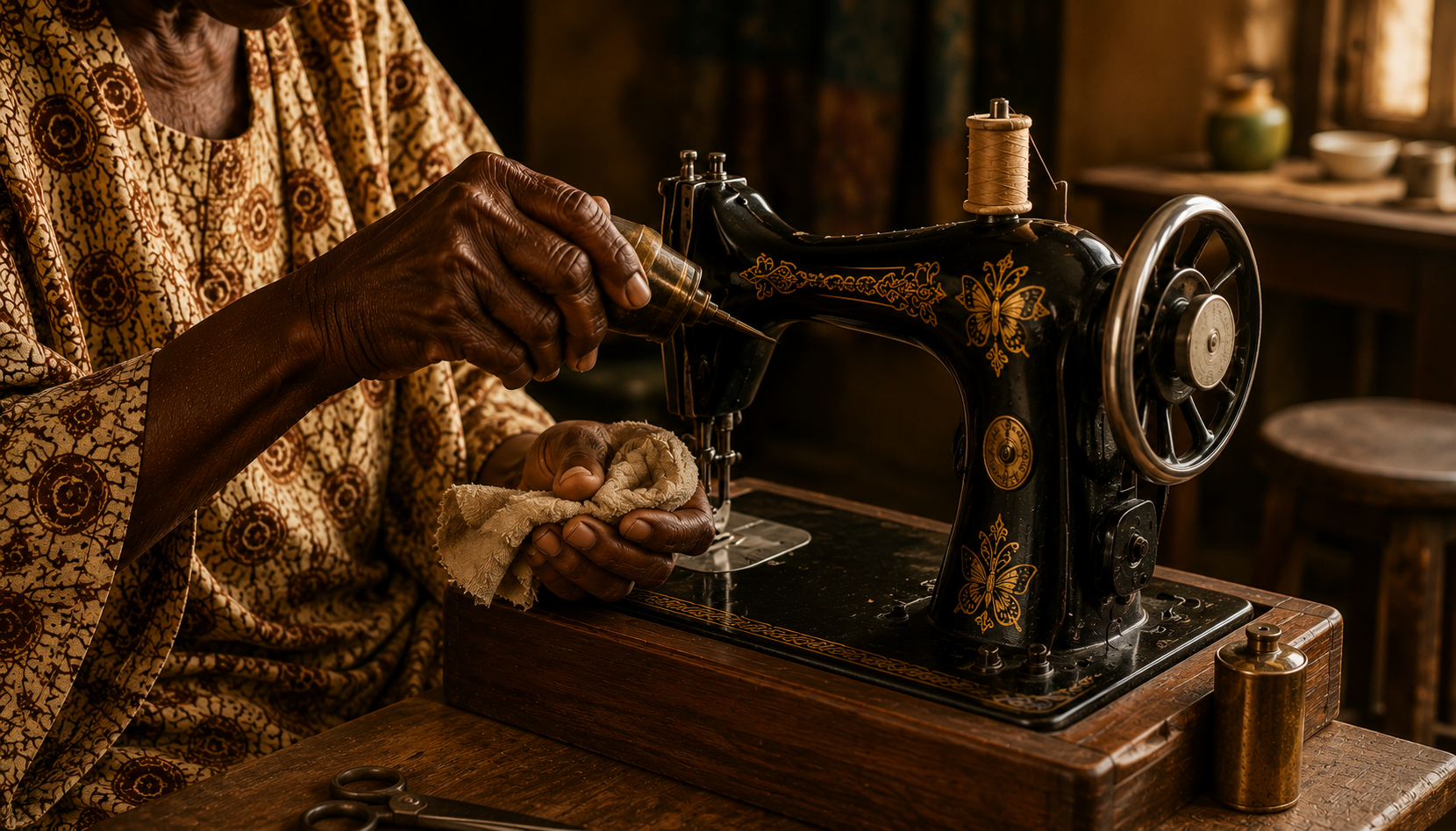
Eventually she looked up and caught me staring. She laughed — the quiet, indulgent laugh of someone who knows exactly how strange she must look to a child who does not yet know what she knows.
"Oko mi, I am feeding my machine.
— Mama Ologi, Osogbo
A machine you feed will never leave you hungry."
I filed it away the way children file things they don't yet have the life to decode. The words made sense — but only the way poetry makes sense before you have lived enough to feel it. I nodded along and forgot it by the time I reached the end of the street.
Years later, when I entered the sewing machine business properly, the memory came back. Because I was finally old enough to understand what I had been looking at.
Mama Ologi's machine — a black head she had bought sometime in the late 1970s — was still running. Forty years. While repairmen on our street made a comfortable living collecting money from the tailors around her, Mama Ologi quietly worked. Her machine never left her workshop. It never cost her a single day's orders. The women who bought new machines every few years would look at hers with that particular Nigerian expression reserved for things they could not fully explain: "God blessed that machine for her."
God had nothing to do with it.
The machines she fed kept running. The machines around her — the ones nobody was feeding, the ones touched only when something went wrong — kept breaking. And the tailors who owned them kept paying.
She had not been performing a mysterious ritual that afternoon. She had been doing something entirely specific, entirely learnable, and entirely repeatable. She had been maintaining her machine the way a skilled person maintains any tool they depend on — consistently, correctly, and before problems could take root.
That is the whole lesson of this guide. It just took me a few more years to understand it well enough to write it down.
When I entered the sewing machine business properly, the stories arrived — and they arrived in waves.
Tailors who had seen three repairmen for the same problem. Tailors whose machine had been "fixed" and returned with a new noise it did not have before. Tailors who had replaced their machine entirely, only to watch the new one develop the same fault within four months. Women who were genuinely skilled at their work, who had invested real money in their equipment, who were being quietly destroyed by a cycle they did not know how to escape.
I heard these stories so many times that I began asking a different question. Not which repairman can I recommend? But: why don't these tailors know how to handle this themselves?
And that was when I remembered the afternoon at Mama Ologi's door. The cloth. The tin of oil. The handwheel turning slowly. The machine that never needed a repairman because its owner never gave it the chance to fail.
After seven years in this business, one particular story kept repeating itself in ways I could not overlook. A tailor would come to me, frustrated beyond words, and say her machine was beyond saving — she needed a new one. I would sell her a new machine. Six or seven months later, the new machine would develop the same fault as the old one.
Same problem. Different machine. Same result.
The machine was never the problem. The knowledge was. And when the knowledge did not change, the result did not change — even with a brand new machine on the table.
That observation is the foundation of everything in this guide.
By the time you finish this guide, you will know exactly what Mama Ologi knew — not as a vague idea, but as a specific, step-by-step system you can begin applying today.
No tools. No technical training. No experience beyond what you already have.
Just the system — written for your machine, your climate, and the reality of running a sewing business in Nigeria. In plain language, from beginning to end.
Before we begin, I want to address something — because I have seen too many tailors lose faith in guides that promised one thing and delivered something entirely different. I want you to know, clearly, what you are holding.
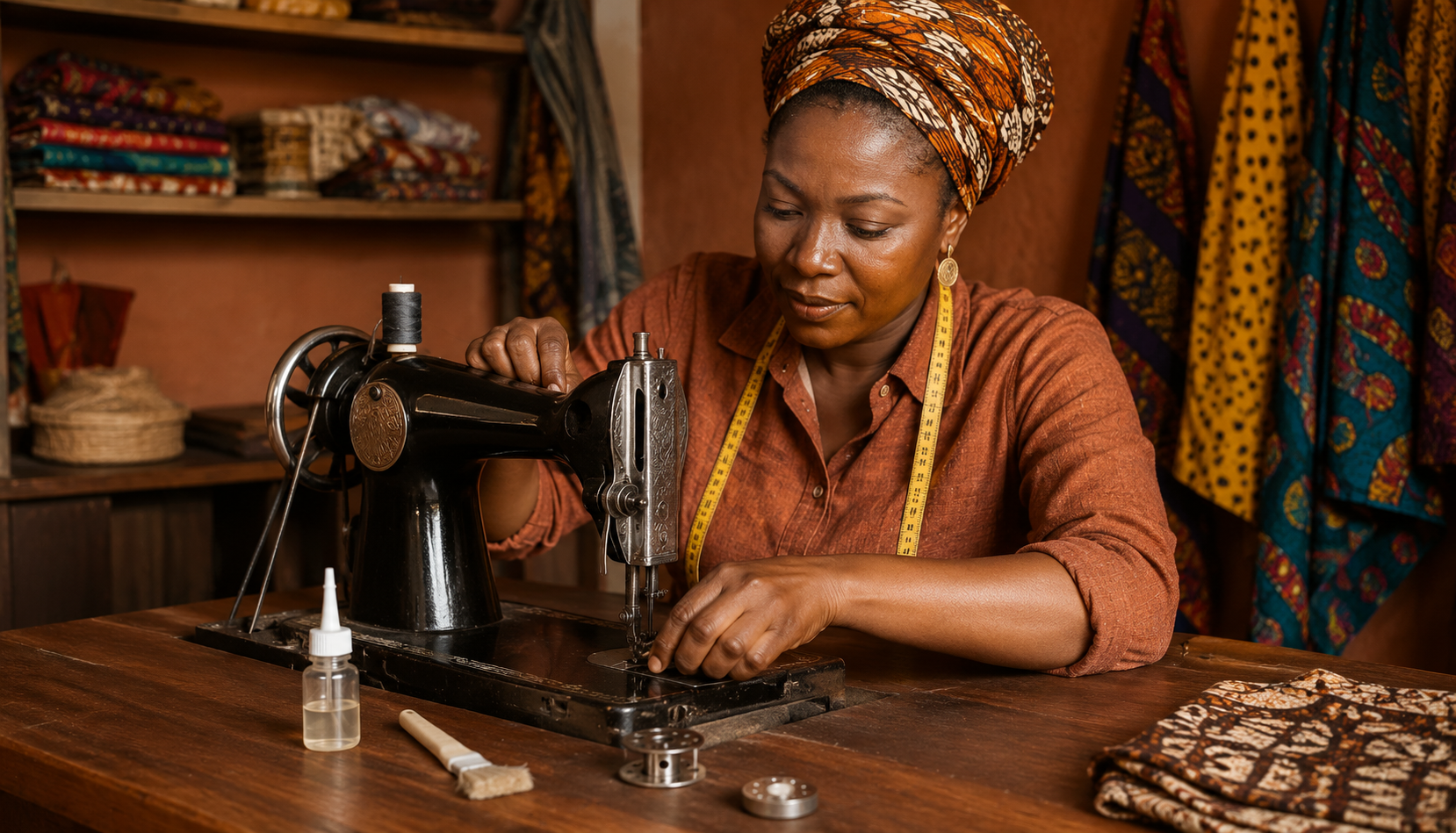
- Not a manual for engineers. You will not be asked to dismantle your machine, diagnose electrical wiring, or perform any repair that requires mechanical training. Everything in this guide was designed to be done by a tailor — not a technician. If a task genuinely requires a professional, this guide will tell you exactly that.
- Not a foreign YouTube video. If you have tried to learn machine maintenance from YouTube before, you already know the frustration: a man in Germany or the United States, working on a computerised machine with specialised tools you have never seen in your life, explaining something that has no connection to the black head sitting in your workshop. This guide was written with Nigerian machines in mind — the machines you actually use, in the conditions you actually face.
- Not generic advice that ignores the Nigerian climate. Nigeria's heat and harmattan dust are not small factors — they shorten oiling intervals, accelerate lint build-up, and create conditions that most maintenance guides written elsewhere do not account for. Chapter 4 gives oiling frequency specifically calibrated for Nigerian conditions. Chapter 6 is dedicated entirely to harmattan. This is not an afterthought.
- Not a guide that requires nearby professional support. Many Nigerian tailors — outside Lagos, outside major cities — work without easy access to repairmen, spare parts, or technical support. This guide was built to function even where that support is scarce or unreliable. The goal is to make you the most capable person in the room when it comes to your own machine.
✔ What this IS: A complete, practical, Nigerian-specific maintenance system. Written by someone who has worked directly with over 920 Nigerian tailors, heard their exact frustrations, and spent years understanding what actually works — with these machines, in this climate, under these conditions.
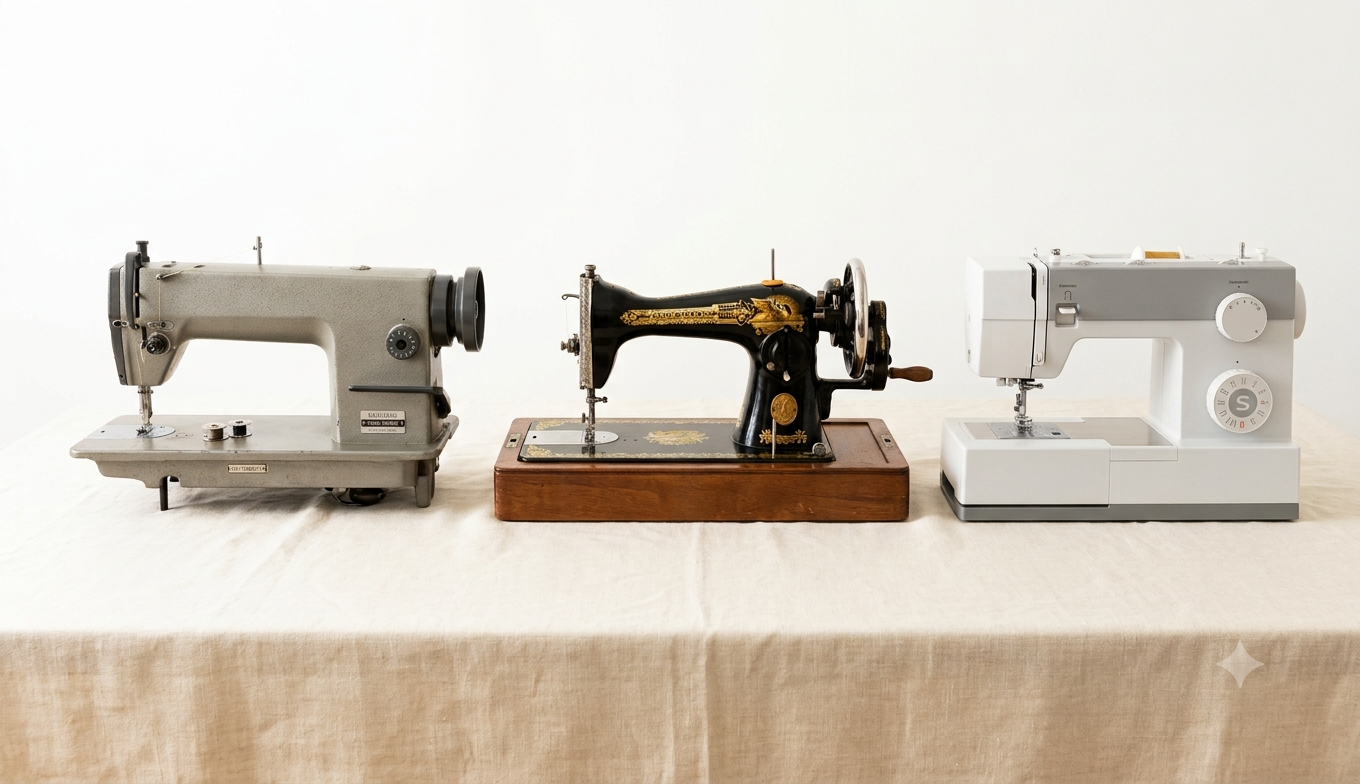
This guide was written for all three machine types used by Nigerian tailors:
Industrial straight sewing machines — the large, standalone table machines (Emel, Two lion, Juki, Xian typical and similar) with a clutch or servo motor underneath, or inbuilt (direct drive). These machines lubricate themselves automatically through an internal oil reservoir.
Black head vintage treadle machines — the classic fully mechanical machines (Butterfly, Brother, Dress, Singer treadle, and older domestic models) powered by foot pedal or hand crank. These require manual oiling at specific points and are often the most durable machines when properly maintained.
Modern tabletop electric machines — the compact machines that sit on a table and run on a built-in electric motor (Butterfly, Toyota, Janome and similar). These also require manual oiling at designated points.
Throughout this guide, each chapter clearly flags where the instructions differ between machine types. If the same step applies to all three, it is written once. If your machine type needs a different approach, you will see it called out so you never have to guess.
If you are using an industrial machine — there is a particularly important note for you in Chapter 4 that you must not miss. It concerns oiling, and it is one of the most common and most damaging mistakes industrial machine owners make.
Now — a word about how to move through what follows.
You do not need to read this guide from cover to cover before you begin. In fact, I would encourage you not to wait.
If your machine is misbehaving right now — if it is making a new sound, bunching thread, jamming, skipping stitches, or refusing thick fabric — go directly to Chapter 3 after finishing this Introduction. The Re-threading Mastercheck resolves the majority of machine faults in ten minutes, at home, with no tools. Many readers have fixed their machine before they have finished reading the whole guide. That is by design.
If your machine is working, but not as smoothly as it once did — not broken, just noisier, stiffer, or less reliable — start from Chapter 1 and read through in order. By the time you reach Chapter 5, you will have a maintenance habit in place that prevents the vast majority of problems before they ever begin.
Either way, the Chapter Orientation Panel below gives you a clear map of what each chapter covers and how long each one takes to implement. Use it to find your starting point.
📋 Your Guide at a Glance — What Each Chapter Covers and How Long It Takes
Use this to navigate directly to your most urgent need, or to plan your reading from the beginning.
| Chapter | What It Teaches | Time to Implement |
|---|---|---|
| Prefatory Page "Know Your Machine" | A visual reference guide to every machine part mentioned in this guide — with clear descriptions and a note on which machine types each part appears in. Read this before Chapter 1 so no term catches you off guard. | 5–10 min reading |
| Chapter 1 The Real Reason | The root cause of the breakdown cycle — and why it is a knowledge gap, not a machine fault. Includes the Self-Audit Checklist: ten questions that identify exactly which habits have been costing you money and which chapters to prioritise first. | 20 min read + 10 min audit |
| Chapter 2 The 3-Phase Protocol | The complete home servicing system — Phase 1 Reset, Phase 2 Restore, Phase 3 Protect. Written step by step for all three machine types. Most readers notice a real improvement in machine sound and stitch quality the very first time they apply it. | 25–35 min (first time) |
| Chapter 3 The Mastercheck | The 10-minute emergency diagnostic that resolves the majority of machine faults — thread bunching, jamming, skipping, clicking — without special tools, without cost, and without a repairman. Includes the Symptom-to-Fix Decision Tree and a dedicated note for overlocker users. | 10–15 min |
| Chapter 4 The Oiling Method | Exactly which oil to use, which oils destroy your machine from the inside, precisely where to apply it, how much, and how often — with a frequency schedule calibrated for Nigerian heat and harmattan. Includes the critical oiling note for industrial machine owners. | 15 min read + implement same day |
| Chapter 5 The Weekly Routine | The complete 5-minute weekly maintenance routine that prevents 80% of common machine faults before they start. Nine steps, a timed table, and a printable wall card to stick beside your machine so the habit never gets forgotten. | 5 min each week |
| Chapter 6 Harmattan Protection | The before, during, and after harmattan protocol — specific steps for when fine dust enters every part of the mechanism. Includes a simple guide to making a breathable, fitted dust cover for any machine type using fabric you already have. | 30 min to read and set up |
| Chapter 7 When to Call | A clear decision list of what you can safely handle yourself and what genuinely requires a professional. Covers how to find a repairman in Nigeria, how to communicate diplomatically, how to protect yourself financially, and a 5-question engagement script that changes the entire dynamic. | 20 min reading |
| Chapter 8 The Long-Term Plan | The complete lifetime maintenance calendar. What a healthy machine sounds and feels like. Early warning signs to act on before a small thing becomes an expensive repair. A closing reflection on what it means to no longer be afraid of your own machine. | 15 min reading |
Before Chapter 1, you will find a page titled "Know Your Machine." It is a visual reference guide — a glossary of the major machine parts mentioned throughout this guide, with a plain description of what each part does and which machine types it appears in.
I included it because I do not want you to pause mid-lesson wondering what I mean by hook race, take-up lever, or tension discs. Every term in this guide is explained there in straightforward language. You can return to it at any point when a term feels unfamiliar.
If your machine looks different from the illustrations in certain chapters — that is fine. Each chapter flags where the instructions differ between machine types. The core principles of maintenance are the same across all three.
The machine you own is not the problem. The machine your neighbour owns is not better than yours. The machine Mama Ologi used was a 1970s black head that other tailors had written off as old and past its time. What kept it running for forty years was not the machine. It was the knowledge — specific, learnable, repeatable — that went into caring for it. That knowledge is what you are holding right now.
One more thing — and I want to say this plainly, before we begin.
This guide was written by a man, but it was built from the knowledge of women. My mother, Mama Fehintolu, who fixed machines in Osun State that professional repairmen had collected money for and failed to repair. Mama Ologi, who quietly kept a 1970s machine alive for four decades while everyone around her assumed it was simply luck. The hundreds of tailors across Nigeria who tested every step in this guide — in their own workshops, on their own machines, under their own conditions — and told me honestly what worked and what needed refining.
I am the person who sat down and wrote it all out in one place, in plain language, so it could reach a tailor in Uyo just as easily as a tailor in Surulere. But the knowledge here belongs to the women who have been maintaining their machines quietly and correctly for generations — long before anyone thought to write it down.
Everything in this guide is practical. None of it requires you to become something you are not. It requires only that you read it, apply it, and give yourself the chance to discover something every woman who has ever maintained her own machine already knows: you are far more capable than anyone has ever told you.
Think about the last time your machine stopped working. What it cost you. The orders that were delayed. The customers you had to call. The money that left your hand for a problem that came back two weeks later.
Now think about Mama Ologi — sitting beside her machine, moving slowly, deliberately, like someone who has long since stopped being afraid of the thing in front of her. Her machine was still running forty years later. Not because she was lucky. Because she was informed.
That is what you are about to become.
Before we get to the system itself, there is something important you need to understand — something that, once you see it, changes the way you look at every breakdown your machine has ever had, and every repairman you have ever called.
It is not what most tailors expect. And it is not the machine's fault. In Chapter 1, you will discover the single most common reason Nigerian tailors keep losing money to repairmen — and why it has nothing to do with the quality of your machine, the age of your machine, or the city you work in.
Once you understand it, you will never be trapped by that cycle again. Turn the page — your real education begins now.