The harmattan adjustments are additions to your existing routine — not replacements. Your weekly five-minute routine, correct oiling schedule, and needle replacement habits continue exactly as before. The only thing that changes is frequency, and the discipline of covering your machine every single day.
Harmattan Protection
Keeping Your Machine Safe During Dry Season
If you have been following this guide from the beginning, you now know how to reset your machine, restore it to working order, rethread it correctly from scratch, oil it properly at the right intervals, and keep it clean through a weekly five-minute routine. You have already built more knowledge than most tailors carry after years of ownership.
This chapter adds one more layer — and it is a particularly important one for Nigerian tailors: how to protect your machine specifically during harmattan season.
Harmattan is not ordinary dust. The fine, dry particles it carries are smaller and more penetrating than the lint your machine produces during normal sewing. They travel through gaps and openings that ordinary dust cannot reach. They settle on oiled surfaces and thicken the oil. They pack into the spaces between moving parts and turn smooth rotation into grinding friction. And because harmattan comes every year — predictably, reliably — the damage it causes is entirely preventable if you know what to do.
This chapter gives you everything: a guide to making a breathable dust cover that fits any machine, a protocol for before harmattan arrives, an in-season routine to follow while it lasts, and a post-harmattan inspection checklist to confirm your machine is fully healthy when the dry season ends.
Why Harmattan Is Different From Ordinary Dust
Your machine produces its own dust — fine lint from fabric and thread — every time you sew. Your weekly five-minute routine (Chapter 5) addresses this. But harmattan brings something different from outside: a dry, wind-carried mineral dust that is far finer than lint, carries no moisture, and penetrates gaps that even lint cannot enter.
Here is what harmattan dust does to a sewing machine when it is left unprotected:
- It thickens existing oil. When fine dust settles on an oiled surface, it mixes with the oil and gradually changes its texture — from a smooth, flowing lubricant into something closer to a paste. This paste creates resistance instead of reducing it. Parts that should glide begin to drag.
- It accelerates wear on the hook race. The hook race is the most sensitive oiling point on your machine — the circular track your bobbin case sits in and rotates around. Fine harmattan dust in this area turns every stitch cycle into a grinding movement. Over weeks, this causes physical wear that can eventually require professional repair or part replacement.
- It shortens your oil's effective life. Under normal conditions, a domestic machine's oiling interval is every eight to ten hours of sewing. During harmattan, that interval shrinks significantly — closer to every five hours — because the dust degrades the oil's performance faster than usual.
- It reaches places your brush cannot. After a bad harmattan season with no cover on your machine, dust reaches internal parts that are not accessible without professional disassembly. This is how harmattan transforms a preventable cleaning problem into an expensive workshop job.
⚠️ Important to Know
A machine that "sounds fine" at the beginning of harmattan season and "sounds rough" by the end has been suffering gradually throughout. The damage is not dramatic or sudden — it is slow, quiet, and cumulative. The goal of this chapter is to prevent that accumulation entirely.
Your First Line of Defence: A Breathable Dust Cover
Before we get to the seasonal protocols, we need to talk about the single most important piece of harmattan protection: a breathable fabric dust cover for your machine.
If your machine does not have one, making it is the most useful thing you can do after finishing this chapter. It is simple to make, requires no pattern, fits any machine type, and costs very little.
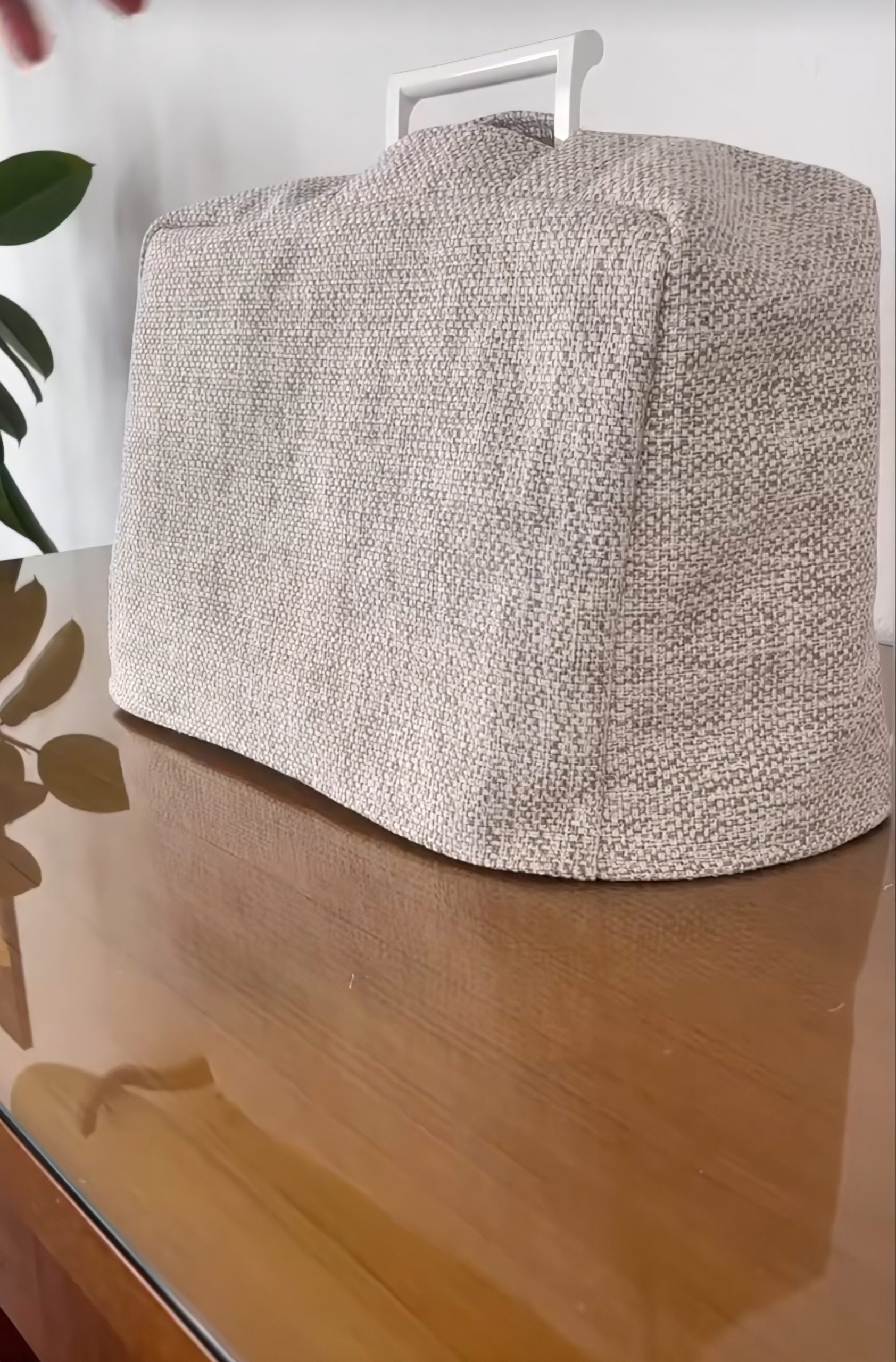
A fitted breathable fabric cover — allows air to circulate, prevents dust from settling.
⚠️ Why Breathable Fabric — Not Plastic
Many tailors cover their machines with plastic bags or polythene sheets. This feels right — plastic keeps dust out. But plastic also traps humidity against the machine's metal parts. In Nigeria's climate, where humidity can rise rapidly after harmattan ends, a sealed plastic cover creates a warm, moist environment that causes rust and corrosion from the inside — damage that is invisible until it is already severe.
A breathable fabric cover — cotton, canvas, or any medium-weight woven fabric — blocks dust while allowing air to circulate. Your machine stays dry, protected, and rust-free.
How to Make a Breathable Dust Cover for Your Sewing Machine
Works for industrial, black head treadle, and tabletop electric machines · No pattern required What You Need- Approximately 1 metre of cotton, canvas, or similar medium-weight woven fabric
- Measuring tape
- Scissors
- Needle and thread (or your sewing machine, once it is running well)
- Optional: 2–4 ribbon, elastic or fabric ties for securing the cover at the base
Take three measurements of your machine. Add 5cm to each one to give yourself ease and seam allowance. Write them down.
| Measurement | What to Measure | Your Machine's Size | Add 3cm → Your Cut Size |
|---|---|---|---|
| H — Height | Tallest point of machine, including handles or spindles sticking up | _______ cm | _______ cm |
| W — Width | Widest point, side to side | _______ cm | _______ cm |
| D — Depth | Front to back | _______ cm | _______ cm |
You will cut three pieces:
- Main piece (covers the top and drapes down the front and back): cut to length = W + D + D, and width = H + H + 3cm seam allowance
- Two side panels: each cut to D × H with 1.5cm seam allowance on all sides
- With right sides together, sew one side panel to each short end of the main piece. This forms a simple box-shaped cover that slips neatly over the sewing machine.
- Hem the bottom edge all the way around: fold under 2cm, press flat, and stitch.
- Optional: Attach two ribbon or fabric ties on each side, positioned near the bottom hem, to secure the cover beneath the machine in a breeze. A single knot underneath is enough.
✅ Result
A fitted, breathable cover custom to your machine's exact dimensions. It sits neatly, protects from above and all four sides, allows air to circulate underneath, and takes less than one metre of fabric. No pattern required. Fits equally well over an industrial machine head, a black head treadle, or a compact tabletop electric machine.
If you also use an overlocker, make a separate cover for it using the same method and the overlocker's own measurements. A covered machine is a protected machine.
🔧 Machine Note — All Three Types
The dust cover instructions above work for all three machine types — black head treadle, tabletop electric, and industrial. Industrial machine heads are larger, so measure carefully and allow generous fabric. If your industrial machine is already on a permanent table and you do not move it, you may sew the side panels closed at the bottom on two sides and leave the back open — creating a hood-style cover that slides on and off easily without lifting.
The Harmattan Season Protocol
The harmattan protocol has three phases — before the season starts, during the season while it lasts, and after it ends. Follow all three phases and your machine will come through each dry season without carrying the damage into the next.
Think of it as a seasonal conversation with your machine. Before harmattan: you prepare it. During harmattan: you check on it more often. After harmattan: you listen to it carefully and make sure it is fully well before returning to your normal schedule.
PHASE 1 — Before Harmattan: Prepare Your Machine
- Complete a full Phase 1 Reset and Phase 2 Restore (as covered in Chapter 2). Start harmattan with a machine that has been freshly cleared of lint, correctly oiled, and rethreaded from scratch. You want your machine in its best possible condition before the dry season adds pressure to it.
- Domestic machines: Deep oil all accessible friction points — hook race, needle bar, and every visible metal-to-metal oiling point. Use 1–2 drops per point. Rotate the handwheel slowly after oiling to distribute. Wipe all excess before sewing.
- Industrial machines: Check the oil reservoir window and top up to the maximum mark with sewing machine oil. Do not add oil to the internal parts manually — the reservoir feeds the automatic lubrication system. Clean the external bobbin area and feed dogs thoroughly.
- Confirm your breathable dust cover is ready — clean, undamaged, and fits your machine. If you have not yet made one, do so now before harmattan arrives. After the season begins, protecting your machine overnight and between sessions is the single most important daily action.
- Stock up on supplies: purchase a small bottle of sewing machine oil and a supply of replacement needles before the season begins. During harmattan, you will be oiling more frequently and replacing needles regularly — having your supplies ready means you are never caught short.
PHASE 2 — During Harmattan: Increase Your Vigilance
- Cover your machine at the end of every sewing session — no exceptions. This is the most important single action during harmattan. The moment you stop sewing for the day, the cover goes on. An uncovered machine left overnight or through a breezy afternoon can accumulate more dust in a few hours than weeks of normal indoor use.
- Increase your lint-clearing frequency to every 2–3 days instead of your usual weekly routine. Harmattan dust accumulates faster than ordinary lint. A machine that would be fine with a weekly clean under normal conditions can begin to labour under combined lint and harmattan dust within a few days during a heavy season.
- Domestic machines — oil the hook race every 5 hours of sewing instead of every 8. Harmattan dust degrades your oil faster. Reducing the oiling interval ensures the hook race always has a clean, effective film of lubricant, even as the dust does its work on the old oil.
- If your machine sits unused for several days during harmattan — perhaps over a long weekend, a public holiday, or a slow week — do a full brush-out of the bobbin area and feed dogs before you resume sewing. Dust settles even on a covered machine if it sits long enough. A two-minute brush-out before you start is better than sewing over accumulated dust.
- Position your machine away from windows and open doorways where harmattan wind enters directly. Even with a cover on, a machine positioned directly in the path of dry-season air will accumulate dust faster than one sited away from the draft. If your workspace allows, move your machine inward during the worst weeks of the season.
PHASE 3 — After Harmattan: Inspect and Confirm Full Health
- Complete a full Phase 1 Reset and Phase 2 Restore (Chapter 2) at the end of harmattan season. Even with the best in-season care, some dust will have entered the machine. The post-harmattan reset clears it thoroughly and returns your machine to its baseline condition before normal weather resumes.
- After the reset, oil all points correctly for your machine type — domestic machines at all accessible friction points; industrial machine reservoir checked and topped up as needed.
- Listen carefully after the reset. Switch your machine on and sew ten stitches on scrap fabric. The sound should return to its smooth, consistent hum — no clicking, grinding, or squealing. A clean, well-oiled machine should be noticeably quieter and smoother after the post-harmattan reset than it was at the peak of the season.
- If grinding or squealing sounds persist after the full reset and correct oiling, this is the signal that harmattan dust has reached internal parts that your routine cleaning cannot access. This is the situation that requires professional attention — and Chapter 7 will guide you through exactly how to handle that conversation with a repairman so you arrive informed, protected, and in control.
Your Harmattan Season Checklist
Use this checklist each harmattan season. Print it if you can and keep it near your machine. It gives you the complete protocol at a glance — before, during, and after — so nothing is forgotten even in a busy week.